SHAPING THE VALLEY
Hornsby Quarry was carved from a band of ancient basal diabase, known as ‘blue metal’ – rock so hard and durable it became essential to Sydney’s growth.
Hornsby Park and Old Mans Valley are remembered not only for farming and orcharding, but also for their role in industrial development.
Formed millions of years ago from molten volcanic rock, this was the only blue metal deposit on Sydney’s north side.
Its location – close to the railway and expanding suburbs – made it invaluable. From the early 1900s, this quiet bushland hollow became a hive of industry under the Higgins family, before Farley & Lewers acquired the site in 1959, expanding and modernising operations.
From the 1920s, the valley’s blue metal (breccia) was quarried to supply road base and building materials for Sydney’s growth. The quarry became a major local industry, employing workers and contributing to Hornsby’s economy.
Over the decades, quarrying dramatically reshaped the landscape carving steep rock faces and terraces that remain visible today. While the work created jobs, it also reduced farming land and replaced the quiet rhythms of orchards with heavy machinery and blasting.
Quarrying continued until early 2000s, when operations ceased. Since then, the site has been reclaimed as part of Hornsby Park, transformed from an industrial scar into a place for recreation, community, and heritage.
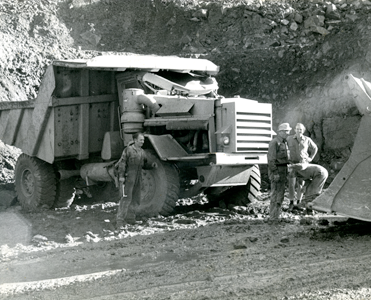
George Dunsten, John Shiach and Jim Mills
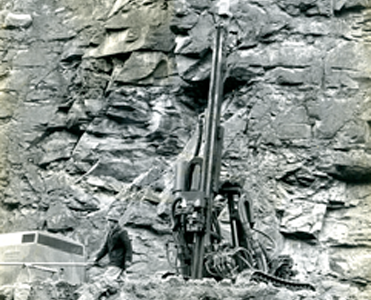
David Hagney
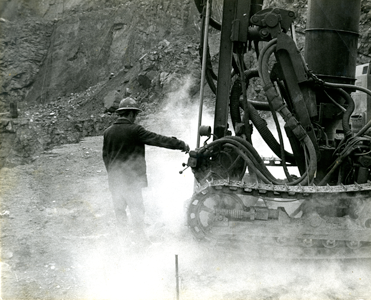
David Hagney using crusher equipment
Echoes of the blast
Explosions that shaped the landscape
Over many decades, controlled explosions in the quarry shifted an estimated 2.5 million tonnes of rock – gradually reaching a depth of 90m below this road, carving out walls up to 30m high.
The foreman would measure where to drill by leaning over the cliff edge with a plumb bob – dangling from a 6m pole. It was risky work with sheer drop offs – no harnesses, no safety gear.
Air rock drills were used to drill up to 50 holes – approximately 1m apart for each explosion. Gelignite and diesel mixed with fertiliser – once stored in this shed and adjacent fuel tanks, was packed into these holes. Each blast could shift up to 30,000 tonnes of rock – bringing the hillside down with a single, thunderous roar. Three times a month, usually on Thursdays at 4 pm, a chime echoed through the valley – then BOOM! The blast known as “the shot” would ring out. All machinery had to be off site 15 minutes prior to the blast but locals gathered to watch, despite the danger.
The shattered rock – known as blast rock – was loaded onto dump trucks by a massive face shovel. Hauling it up the steep quarry road to the Crusher Plant was slow work: a 15-minute climb in first gear.
CRUSHER PLANT
INSIDE THE CRUSHER
THE CRUSHER PLANT WAS THE BEATING HEART OF THE QUARRY – WHERE BLASTED ROCK BECAME THE GRAVEL AND ROAD BASE THAT BUILT SYDNEY
A DANGEROUS TOWERING MAZE
Quarryman Peter Milgate recalls how after
blasting, the rock was hauled out of the pit – a 15-minute climb in first gear. It was a relentless loop of diesel, dust, steel and stone.
At the top stood the crusher – a cramped, noisy and dangerous towering maze of conveyor belts and chutes that reduced boulders to ballast, and raw rock to road base.
“Inside, belts criss-crossed everywhere. Miss a step and you’d lose a finger.”
THE BOOT
Trucks tipped their loads into the ‘boot’ – a huge funnel that fed directly into the spinning crusher.
When rocks jammed in the boot, workmen would crawl under it with an air drill, to bore a hole into the jammed rocks, pack it with gelignite, and blast it loose – all while the crusher was still turning!
BLOW BARS AND BLUE FOG
Inside the boot, a massive steel rotor spun with six ‘blow bars’ that hurled stone against hard plates to break it down.
The thickness of each blow bar was beaten and worn down two inches (50 millimetres) every day. Each bar had to be rebuilt by a welder overnight to be ready for the next day’s relentless battering.
The whole plant thundered like a heartbeat through the valley.
Each impact broke the rock smaller until it fell onto vibrating ‘screens’. Oversized rock recycled through the ‘secondary crusher’ and ‘fines’ spilled onto conveyor belts to graded stockpiles.
Dust rolled out in blue clouds – ‘blue fog’, the men called it.
“ Your teeth were gritty by lunchtime and your overalls stood up by themselves. You wore the job home.”
SATURDAY WAS FOR SHOVELS
Noise restrictions meant no crushing on weekends. Saturdays were for shovelling spillage, repairing belts, and maintaining vehicles.
Six days a week – there was always something to fix. Pride ran deep.
“We kept it running. If a belt tore, we stitched it with wire. If a bearing failed, we found a way. A bit of wire, a hammer, and a lot of nerve – that’s how you kept it going.”
As the machines grew larger, the quarry workforce shrank – Bigger machines. Fewer blokes. More noise.
THE SOUND OF PROGRESS
The quarry gave form to Sydney’s roads and suburbs – Warringah Road, Mount Colah, Asquith and far beyond.
Few locals realised the extent of it, though everyone knew the sound … from dawn to dusk, the steady rumbling grind of stone and the echoing blasts that shook Hornsby Valley.
ECHOES IN THE STONE
Today, the crusher stands silent, but its story endures in the terraces and haul roads etched into the valley – the foundations of a park built on its own past.
“Back then we couldn’t imagine it’d ever become a park. Something really beautiful has come from this place that once shook the ground.”
EACH BLAST, EACH TRUCKLOAD, EACH THUNDEROUS TURN OF THE CRUSHER HELPED BUILD A CITY SPREADING FAR BEYOND THE RIDGE TOPS. THE QUARRY’S PURPOSE WAS SIMPLE: ‘TO WIN THE ROCK’.
But the story didn’t end when the blasting stopped. As Hornsby Park rises around the old pit, the memories of quarryman Peter Milgate recall a time of dust, danger and camaraderie – when winning the rock quite literally built the city.
A LOCAL BOY IN A BIG PIT
“I grew up just around the corner,” Peter recalls. “As kids, we’d sneak down for a swim in the quarry. No fences. No rules. Just cold, deep water.”
Born in 1950, Peter spent his childhood roaming Hornsby’s bush tracks. At 18, the quarry became his workplace.
“I fell in love with the place – the noise, the dust, the machinery. It was rough and real.”
BLASTING DAYS
Operations followed a steady rhythm of marking the quarry face, drilling and charging, then ‘firing the shot’. The quarry walls – some over 30 metres high – were slowly eaten away by controlled explosions.
“We’d lean over the edge with a plumb bob to mark where to drill the blasting holes. No harnesses, no safety gear.”
Each blast (‘shot’) might shift 20,000 tonnes of rock. Gelignite and fertiliser mixed with diesel called ‘nitro-pril’ – packed into holes drilled 4 metres into the quarry face, would bring the hillside down in a single thunderous roar.
Three times a month, typically on a Thursday, a chime would echo through the valley.
“Everyone stopped and waited. Then at 4 p.m. sharp … BOOM! Rocks the size of cars would fly across the pit. People came to watch, even though it was dangerous. One bloke 200 meters away even lost two fingers to a flying rock.”
MATES, MACHINES AND MEMORIES
The risks and shared danger created strong bonds of trust and pride in the work. “It was like a family,” Peter recalled. The lunchroom buzzed with the accents of a diverse workforce – Australian, English, Scottish, Irish, Dutch, German, and Italian.
Meals were simple – sandwiches or a “Dixie” tin of leftovers, warmed in the oven. “There were no cafés. Just your mates, your lunch, and a lot of dust.”